Frogs in slowly boiling water – Russian environmental groups adapting to harsh conditions: 2024 status update
During several years, the situation for the Russian environmental movement has been gradually worse. In 2024, we have seen legal changes that worsen the situation. We have experienced fewer cases of prosecution, but with higher severity.
Frogs in slowly boiling water
Summary
During several years now, at least from 2012 onwards, the situation for the Russian environmental movement has been gradually worse. Seen from the outside, especially over a longer period, the situation is shockingly dire. In 2024, we have seen legal changes that worsen the situation. We have experienced fewer cases of prosecution, but with higher severity.
In Russia, environmental groups and activists have adapted to harder conditions but have also been getting used to the gradually worsening of the situation each year. Thus, each additional human rights limitation can be considered as just another turn, as a frog being put in cold water, slowly coming to boil.
Environmental groups and activists that remain in Russia despite the hard conditions, strongly underline that it is still possible to do some relevant work. Of course, they must adapt, for instance by choosing less provocative work methods and to reduce open critics of the regime. Russian activists living abroad help with distribution of information, and other work that has limited possibilities from inside Russia.
Table of contents
Introduction
Naturvernforbundet has been following the situation for Russian environmental civil society closely since 2012, when the law on organizations performing the functions of a foreign agent, came into Russian law. Before that, environmental groups and activists faced pressure from Russian authorities, but the 2012 law still marked a change. From 2012 onwards, Russian environmentalists have told us of worsened situation, each year. Some years small but steady, other years larger leaps.
Russia’s full-scale invasion of Ukraine in 2022 and de-facto war-censorship marked another milestone in shrinking of democracy and repressions against civil society, including the environmental movement.
As usual, the actual conditions are unclear, since laws are vague and the limits difficult to predict. For Naturvernforbundet, it has been noticeable that environmental groups and activists generally don’t describe their working conditions in 2024 as worse than the year before. People might be nervous for their security, but no-one is saying working with environmental issues is impossible.
In fact, Russian environmentalists we have contact with, emphasise that work is still possible. Maybe they got used to the situation, and therefore speak more positively about it? Or maybe they choose to stay hopeful instead of giving up their work, and thereby giving in to an authoritarian regime?
The current situation for Russian environmental groups and activists
During the year 2024 we have seen more adaptation by the different actors in the environmental movement. Professional environmental NGOs and experts have found a seemingly safe and comfortable visibility level in order to continue their work without putting themselves at the vulnerable spot. Grassroots groups have been looking for other methods of defending their rights than direct protesting, since repressions keep increasing.
At the same time environmental problems in current Russia have become increasingly acute. This has been exacerbated by the several crises of the last couple of years. Increased economic pressure, redistribution of state resources towards military needs, and restrictions on civil society have significantly impacted the environmental situation in the country. We write more changes in environmental laws in a later chapter.
Major oil spills from a collision of two Russian oil tankers in the Kerch strait (which separates Russia from annexed Crimea) in the Black Sea in December, clearly showed that the Russian authorities are unable to properly address catastrophic events. In contrast to the officials’ inaction, thousands of volunteers managed to self-organize and start urgent clean-up actions in the absence of the state. Professional environmental groups and experts were able to advise and guide those volunteers to the most impactful direction of action.
An online petition to the Russian president Vladimir Putin and the Head of the Russian Emergencies Ministry Alexander Kurenkov, published at Change.org platform calling for declaring a federal emergency, rapidly reached 20 000 signatures (in April 2025 over 100 000 signatures) and forced Russian authorities to declare a federal level state of emergency. A Telegram-chat for volunteers of the Black Sea oil spill amounted to over 100 000 people.
In what can be described as a depoliticized society, we see how Russian civil society in a moment of catastrophic events realizes itself in direct actions for environmental protection.
Current legal regulation of «foreign agents»
In 2024, the regulation of control over persons who exercise the functions of foreign agents was changed. Now, those labelled foreign agents have less rights.
As background information, it can be noted that 2012 was the first time the concept of «an organization exercising the functions of a foreign agent» appeared in the Russian federal laws, the laws «On Non-Commercial Organizations» and «On Public Associations». An organization receiving funds from foreign sources or from Russian legal entities with foreign funding would be designated as a foreign agent. Before starting a political activity, the public association was obliged to submit an application to the registration authority for its inclusion in the Register of non-commercial organizations exercising the functions of a foreign agent (art. 29 of the Federal Law «On Public Associations»). In this regard, the association had additional significant responsibilities: to maintain additional records and report quarterly to state agencies, to put a label of «foreign agent» in all its publications, and to register with fiscal authorities and the Ministry of Justice. We have written about this law several times, in yearly presentations[i].
Further changes were made in 2022, when the key law «On Control over the Activities of Persons under Foreign Influence»[ii] appeared (entered into force on December 1, 2022). This act summarized almost all the provisions of other laws related to foreign agents. The 3 main changes from 2022 are summarized below[iii].
- Firstly, the labels «a non-commercial organization exercising the functions of a foreign agent» and «a mass media exercising the functions of a foreign agent» have been replaced with the more simple and offensive notion of «foreign agent». Therefore, many organizations have stopped their activities or are looking for quasi-legal alternatives.
- Secondly, a foreign agent can be not only a legal entity, but also any unregistered association or structure, as well as any individual.
- Thirdly, the concept of a «foreign agent» has become even more vague. Foreign financing is no longer required for foreign agent status. The new provision has appeared: «…receives support from abroad and (or) is under foreign influence». Besides, foreign influence refers to ANY assistance from a «foreign source.» Moreover, the legislator mandates that all materials published in media or online, as well as official requests and appeals to state authorities and local governments should be labelled as originating from a foreign agent.
Any Russian citizen with an active position mentioned in foreign agent media can be labelled a foreign agent. Citizens collecting information about military and military-technical activities (the list of such information is published by the Federal Security Service) can be designated as foreign agents. The law also required the Russian Ministry of Justice to maintain one register of foreign agents instead of four, and a register of individuals affiliated with foreign agents.
Currently, the legal status of persons affiliated with «foreign agents» remains undetermined, and restrictions on «foreign agents» do not apply to them. An exception is the obligation of a citizen or an electoral organization to provide such information to the election commission in cases of candidacy for any election to public authorities. The register of individuals affiliated with foreign agents is not published. A person may only request the Ministry of Justice of Russia about their own inclusion in this register. Public authorities may also request this information.
The restrictions on the rights of Russian citizens designated as foreign agents have become a prominent legal issue. Unfortunately, little attention is paid to this issue, and such restrictions are growing annually. However, from a legal point of view, this is significant, as it concerns the possibility of implementing the main constitutional principles: equality before the law and the court (Article 19 of the Constitution of Russia) and the inviolability of fundamental human rights and freedoms (Article 17).
In 2024, prohibitions on holding state and municipal positions and restrictions on electoral rights were supplemented with an additional list of restrictions. It is forbidden to be elected at any level, to be an election observer, to be a member of electoral commissions, etc.
«Foreign agents» are prohibited from teaching in state and municipal educational organizations, making educational products, any creative activity with state financing, providing environmental and anti-corruption assessments, organizing public events, etc.
In addition, since 2024 the citizens’ control of environmental protection has been prohibited, due to changes in the legislation of public control procedures. Those labelled foreign agents cannot participate in public control in general, including in environmental control. Foreign agents are deprived of this right.
Also since 2024, advertising on foreign agent resources and advertising of foreign agent information resources in the media is prohibited. In total, there are more than 20 restrictions on rights, compared to other citizens.
On December 17, 2024, the State Duma of the Russian Federation adopted in the third and final reading new amendments to the law «On Control over the Activities of Persons under Foreign Influence.» According to the amendments[iv] the income of foreign agents from the sale and rental of real estate and vehicles, as well as from dividends and deposit interests, and royalties from the use of the intellectual property and trademarks, will be transferred to special rouble accounts. A «foreign agent» loses control of his income until this status is cancelled. The state freezes all incomes of «foreign agents», depriving them of their livelihood.
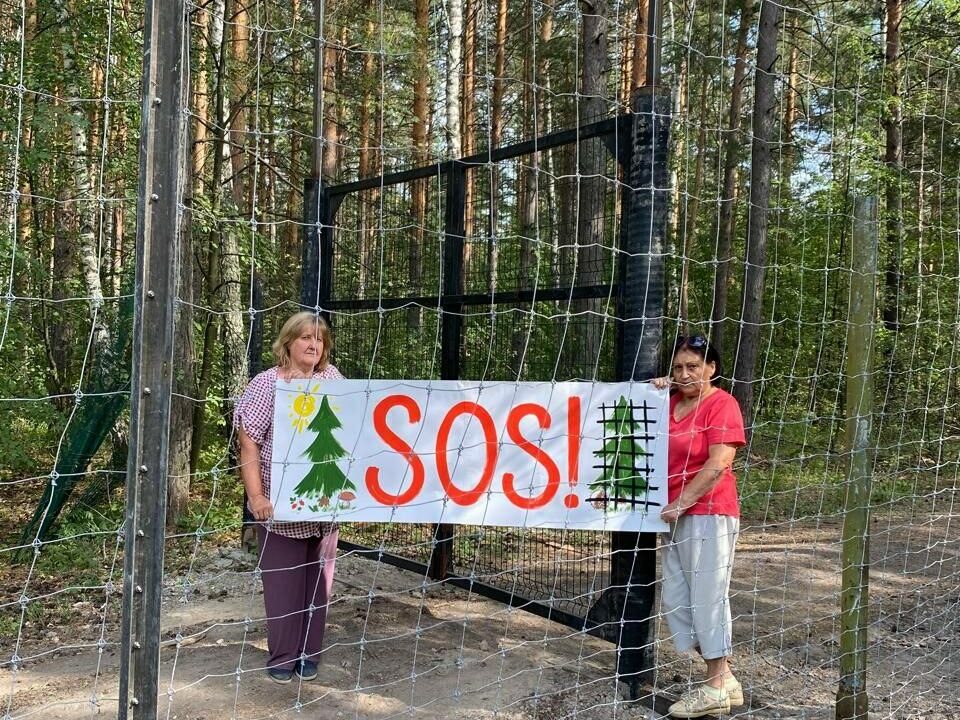
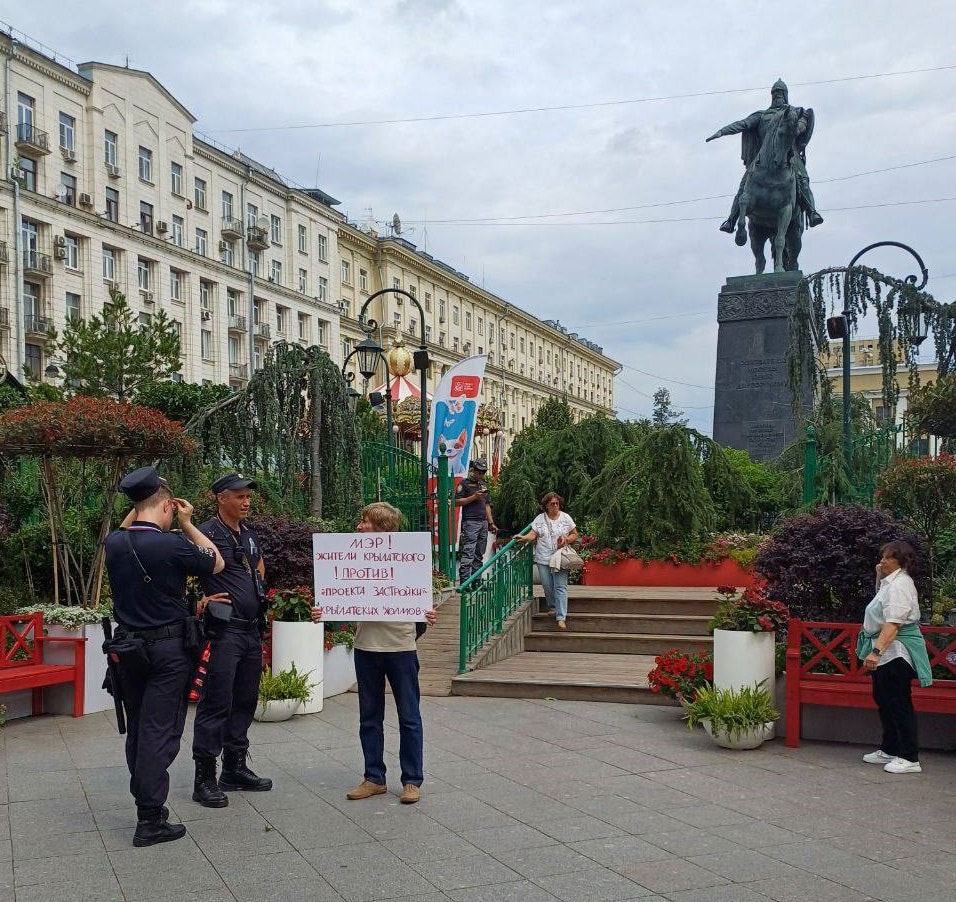
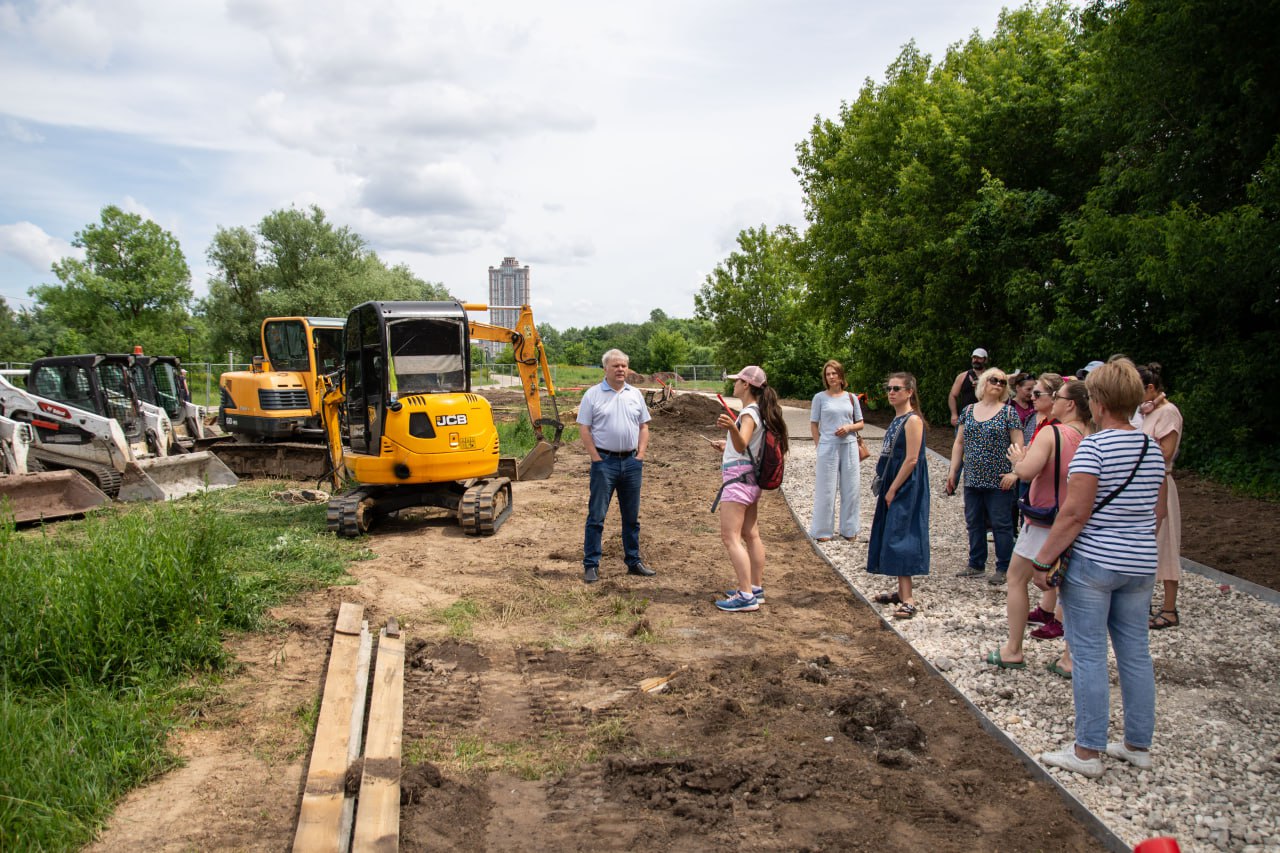
Picture at the top: Protest against “preoccupation” by business with the forest in Smorodino in Sengileevsky district.
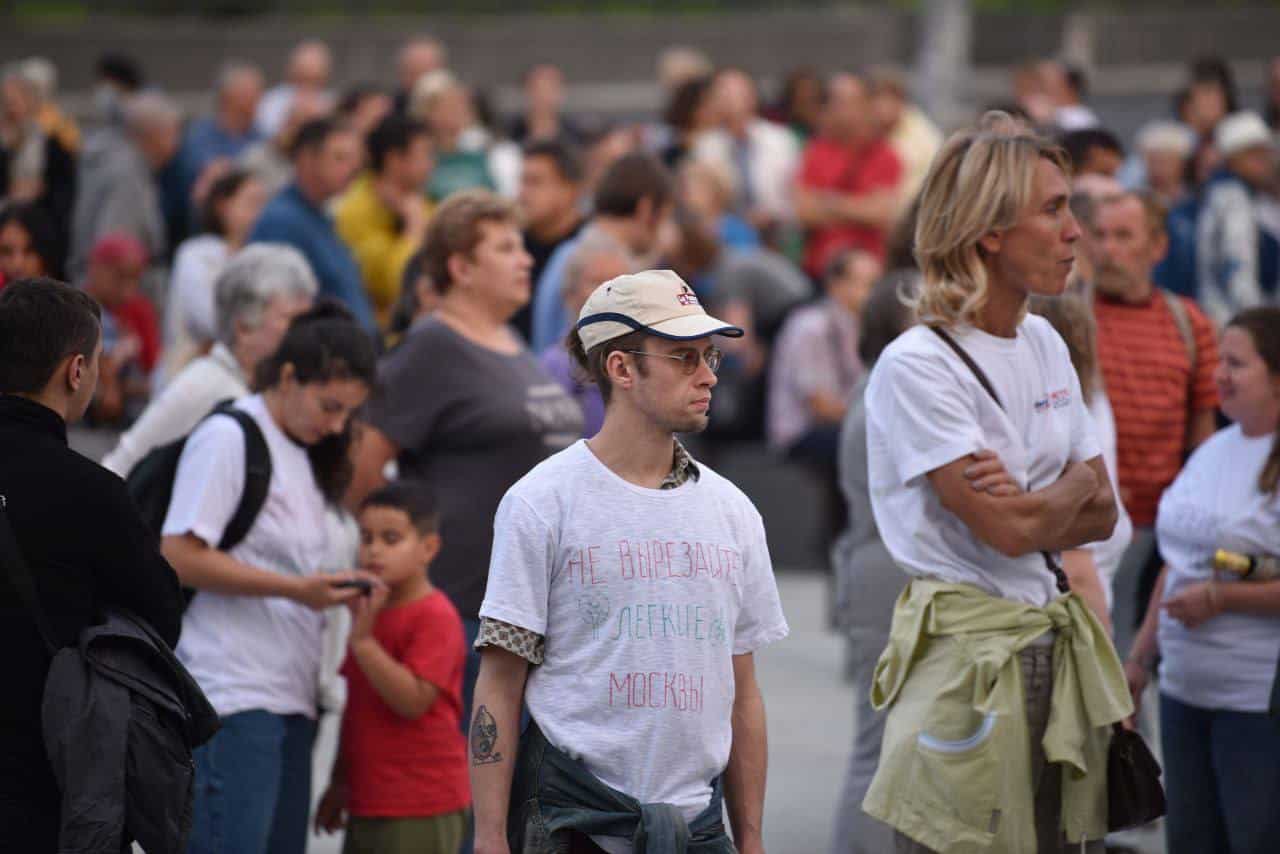
Picture at the bottom: Meeting with State Duma deputy on the problem of development of Krylatskoe district.
Prosecution practise and numbers in 2024
The Environmental Crisis Group documents persecution of Environmental human rights defenders (EHRD) in Russia. In their annual report on persecution in 2024, the group has documented 95 new cases against 72 activists, 15 grassroots groups and 5 environmental organizations in 27 regions of Russia. The information in this chapter is taken from this report.
Compared to the previous year, we see fewer cases of pressure: in 2023, more than 174 environmental activists and 29 environmental associations were persecuted in Russia.
The lower numbers could be due to a decline of protest activity as a form of environmental protection: there are fewer environmental protests in 2024. But people are looking for other, non-conflict forms of protest to protect their environmental rights. Among such methods are appealing to the GONGOs[v] or pro-Kremlin organisations with environmental focus, using patriotic rhetoric of «motherland defenders» and pasting Putin’s portraits to trees in order to protect them.
We want to emphasize that the reduction in the number of pressure episodes does not indicate a decrease in pressure on environmental activists in general. At the same time, pressure is becoming more severe. For example, the terms of criminal punishment have increased significantly.
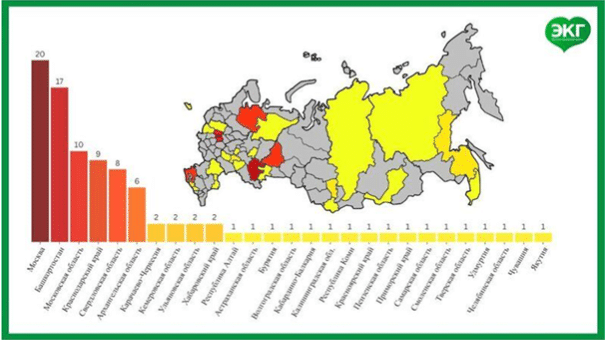
The leading regions with persecution are correspond with most active regions from year to year. In 2024 these are Moscow (20 episodes), Bashkortostan (16), Moscow Oblast (10), Krasnodar Krai (8), Sverdlovsk Oblast (8), and Arkhangelsk Oblast (5). See the map and the graph below (figure 1).
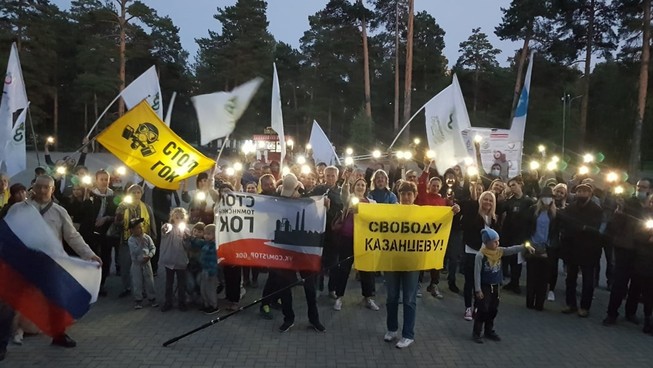
In 2024, two activists died because of persecution. In January, Vladimir Grigoriev, a defender of the Smolensk protected area «Khmelita», was found dead. Grigoriev’s comrades note that the man did not complain of health problems, and his death was «unexpected and strange.» A computer and other equipment also disappeared from the activist’s home. A week later, Grigoriev’s dogs were brutally killed. In December, eco-prisoner Vladimir Kazantsev, a lawyer for the «Stop GOK» movement, died in a colony in Chelyabinsk region. None of the deaths was properly investigated by the authorities.
The most severe cases of persecution include cases of forced psychiatry. Two Krasnoyarsk anti-nuclear activists were sent for forced psychiatric examination: Evgenia Elizarieva and Natalia Podolyak.
Another alarming case is the arson of the house of the defender of Moscow natural areas Elena Koltsova, and the beating in the Krasnodar region of the animal rights activist Denis Dzhalaganiya.
We want to point out that environmental activists are jailed for doing what most Europeans consider to be completely ordinary, for expressing free speech. In January 2024, environmental activist Fail Fattakhovich Alsynov was sentenced to four years in prison for speaking at a public gathering in the republic of Bashkortostan, south of the Ural Mountains. We have previously written about the Bashkir fight for nature protection[vi], which has gone hand in hand with language preservation and ethnic identity. Understandably, people were angry about Alsynov’s prison sentence, and his supporters protested, leading to a series of cases of mass riots where 69 were detained. In December, five protesters were sentenced to prison, up to 8,5 years.
At the same time, the situation is not only dark: several cases of punishment for those who attacked environmental activists, have been documented. Please note that while this might seem obvious for a European reader, it has often not been the case in Russia.
For example, two court decisions were made on cases of attacks on environmental activists and journalists. Both cases are in the Moscow Region. First case is an attack on a «Vesti» news crew filming a report on the development of the Sinichka River in Krasnogorsk, Moslow region. In a court ruling, an employee of a private security company received 1.5 years of imprisonment. The second case resulted after a beating of a public environmental inspector after his remark about burning waste at a Russian Railways construction site. Here, the attacker was given an administrative fine of 5,000 rubles.
We want to emphasize that the main conclusion is not the numbers in itself, but the positive fact that environmental resistance in Russia continues and are even sometimes able to achieve justice.
Weaker environmental legislation in 2024
Russian environmental and natural resources legislation changed for the worse in 2024, as in the previous years.
The 2024 changes have weakened environmental protection requirements and expanded the possibilities for uncontrolled use of natural resources. Some laws and regulations have already been adopted, while others are under consideration. The reason for the relaxation of environmental requirements, according to legislative and executive authorities, is the current «macroeconomic and geopolitical situation» related to war against Ukraine. Therefore, official authorities suggest lower environmental standards for economic development. We propose another reason: anti-democratic domestic policies weaken civil society, reducing effective environmental public control. Below are some examples of weakening of environmental and natural resources legislation in 2024.
On September 1, 2024, amendments to Article 98 of the Land Code of the Russian Federation entered into force allowing the construction of various infrastructure facilities on recreational lands. In 2023 the placement of capital facilities for recreational activities was allowed on the forest lands and lands of specially protected natural areas. Now the recreational lands are the next area to be impacted. The extensive list of such facilities was approved by the Government of the Russian Federation (Directive №1372-r, June 1, 2024). Furthermore, from the legislators’ perspective, such a construction project can be realised without a state environmental assessment. Thus, areas of national heritage will be severely affected by recreational activities with irreparable damage.
In addition, funding for federal and regional environmental programmes has been significantly reduced. For example, financing of federal projects that are part of the national project «Ecology» was significantly reduced; project «Clean air» until 2026 was reduced by 6 billion rubles or 42 %; project «Clean country» – by 30 %; project «Wellness of Volga» – by 12 %.
In 2024, the Government of the Russian Federation renewed various permits and licences for natural resource users, including those for temporary emissions and discharges of pollutants from hazardous industries. Additionally, deadlines for implementing measures to reduce emissions and discharges have been extended.
On September 1, 2024, significant amendments to the federal law «On state environmental assessment» and other legislative acts changed subjects and the procedure of state environmental assessment on federal and regional levels. In some cases, it allows changes in projects that have a negative impact on the environment without state environmental assessment. Furthermore, some projects located within the Arctic zone of Russia are exempt from state environmental assessment. The list of projects eligible for this exemption will be determined by the Government of the Russian Federation.
It should be noted that in Russia, there are three kinds of environmental assessments. Before we continue describing the changes, we list them here, to limit confusion for the reader:
- Environmental assessment – экологическая экспертиза
- Non-governmental environmental assessment – общественная экологическая экспертиза (which is initiated and financed by citizens)
- Environmental impact assessment (EIA) – ОВОС
From September 1, 2025, non-governmental environmental assessment will be allowed to be conducted only by experts who have passed state certification. This requirement did not exist before, and is obviously limiting the role of civil society. The certification procedure is outlined in Order No. 110 issued by the Federal Service for Supervision of Natural Resources Management (Rosprirodnadzor), February 25, 2025.
The number of subjects of state environmental assessment was dramatically diminished for the purposes of drafting documents in the area of regional environmental protection and natural resources management on the regional level.
In connection with these changes, a completely new provision on state environmental assessment was adopted (Resolution No.694 of the Government of the Russian Federation of May 28, 2024).
Reducing the number of environmental assessment subjects and environmental requirements cannot effectively provide the realisation of the constitutional right to a favourable environment. This right includes preventing negative impacts of economic and other activities on the environment in the period of projecting.
All these factors diminish the importance of environmental assessment as a legal institute intended to ensure the citizens’ right to a favourable environment.
Moreover, in 2024, new regulations for the Environmental impact assessment (EIA) were adopted (Resolution No. 1644 of the Government of the Russian Federation, November 24, 2024). This document establishes new limitations on citizens’ access to environmentally relevant information regarding upcoming construction projects that may negatively affect the environment. Thus, there is no requirement to include in published EIA materials such significant information as data related to technological processes, characteristics of land plots, sources of raw materials for technological needs, water consumption indicators, assessment of the impact on natural environment components, including assessment of possible transboundary effects, etc.
Now, the rules do not require the project’s owner to organise public hearings. From 2024 public hearings will take place only if initiated by citizens or authorities. Information about the project must be presented, and citizens have 7 days to require a public hearing. If no such initiative is pursued, the hearing does not take place.
In 2024, the Government of the Russian Federation adopted new procedural rules for issuing permits for radioactive substances emissions and discharges (Resolution No. 99 of the Government of the Russian Federation, February 2, 2024). Compared to the previous regulations in 2018, the adopted document simplifies the procedure for issuing permits for radioactive substances emissions and discharges into the environment. For example, it is no longer necessary to carry out a preliminary sanitary and epidemiological assessment by the Federal Service for Surveillance on Consumer Rights Protection and Human Wellbeing (Rospotrebnadzor) to ensure compliance with sanitary regulations, nor to provide a corresponding conclusion to the Federal Service for Environmental, Technological and Nuclear Supervision (Rostekhnadzor).
In June 2024, the second reading of the bill on amendments to the federal law «On the protection of Lake Baikal» was held. This draft law permits clear-cutting in the central ecological zone of the Baikal Natural Territory for construction, reconstruction and operation of engineering protection structures for territories and facilities, objects of public utility infrastructure, facilities for temporary accommodation, food services and consumer services, and roads. The bill allows the transfer of the forest land of the Lake Baikal zone into land of settlements, including for military and civil cemeteries.
The mentioned legislative innovations indicate that current legislative processes aimed at weakening environmental protection and natural resources management legislation.
The situation is aggravated by the low quality of legislative technique of the legislative bodies of the Russian Federation, which has been reflected in the legal literature. The legislation on environmental protection and management is changing constantly, although previous acts have not yet lost their relevance, and in some cases, law enforcement is not stable.
Only a thorough analysis of environmental legislation and law enforcement will help to understand and assess the reasons for the insufficient effectiveness of existing legal mechanisms, identify and eliminate legislation defects.
To conclude, it can be noted first that the development of federal environmental protection and natural resources management legislation is unstable, with tendencies towards “de-regulation” of environmental legislation, in fact ruining environmental legislation. Second, in today’s Russia, socio-economic interests prevail over environmental ones. Sanctions policies serve only as a catalyst for this trend.
At the moment, the destruction of environmental legislation is aggravated by the anti-democratic changes described earlier in this text.
Unfortunately, the above-mentioned legislation changes (and please note that this is not an exhaustive list) are aimed at reducing the influence of civil society on internal political life, including environmental matters, in Russia. Citizens’ control is losing its significance, which negatively affects the environment, allowing to exploit natural resources without control and to ignore the interests of Russian citizens.
In challenging times, there is a growing tendency to address economic issues by exploiting our invaluable and unique natural resources. However, this approach often fails to resolve the underlying economic difficulties and can result in the irreversible loss of precious natural sites.
How can you help? Recommendations from Russian environmental groups and activists
Environmental problems are global and a strong and independent civil society is a necessary condition for democratic transformations and the integration of post-war Russia into the world community.
Below, we have collected advice and requests from our contacts in the Russian environmental community.
1. The isolation of the Russian regime should not extend to Russian civil society
International sanctions should be aimed at Russia’s ruling and economic elites, as well as dangerous and dirty technologies and industries, and not at the general population and civil society.
The import of fossil fuels, as well as nuclear technologies and materials from Russia, should be stopped as soon as possible. This will help not only to stop the war but also cope with the ecological crisis.
2. Global environmental problems cannot be solved without Russia
To solve the ecological and climate crises, it is important to maintain a minimal interaction with Russian authorities. In such cases, it is vital to also consult and listen to representatives of independent ecological organizations and indigenous peoples’ organizations located in Russia or in exile.
3. Environmental work and protection of environmental rights are still possible in today’s Russia and should be supported
In principle, concern about environmental issues and the protection of environmental rights are still perceived by the Russian authorities as legitimate civil activity. Despite pressure and worsening human rights conditions, environmental groups and activists still manage some relevant activities.
Support for the environmental community and activists who protect their environmental rights in Russia is a contribution to the democratization of Russian society and a strong civil society in the future of Russia.
4. Security and relocation for civil society representatives
Understanding the risks that civil society activists face daily in Russia, it is necessary to help environmental activists and other human rights defenders if they need to flee Russia.
The feeling that the European community will provide the necessary support in difficult times, and the possibility to re-locate in Europe, helps many of them to continue their work.
5. Cooperation between civil societies must remain a priority
Despite all the difficulties and risks of interaction, maintaining contacts and cooperation between civil societies of European countries and Russia should continue. Russian civil society should remain integrated into the European community in order to become agents of democratic change at the earliest opportunity.
This means that efforts and resources for such interaction should not be reduced, including providing visas for human rights activists and other civil society activists.
References
[i] See for instance our article from mars 2024 «Human rights conditions for environmental civil society in Russia: 2023 status update».
[ii] The law can be found here (in Russian): https://www.consultant.ru/document/cons_doc_LAW_421788/
[iii] We have written about these changes in our report published in 2023, «Environmental struggles in wartime – status of Russia’s repressive legislation and implications for environmental defenders».
[iv] From the webpage of the state Duma, «Law passed to strengthen control over activities of foreign agents»: http://duma.gov.ru/news/60601/
[v] GONGOs are an abbreviation for Government organised non-governmental organisations. This contradiction means an organisation that is either organised by the government or at least partially controlled by it, while being presented as independent and free.
[vi] For instance in our report «NOT SILENT BEFORE THE STORM. Status of Russia’s foreign agent laws and implications for environmentalists in 2021», pages 17-18 and 21-22.